
Helping Our Neighbors Experiencing Homelessness.
Homelessness is a Public Health Crisis.
Homelessness is a public health crisis that affects individuals, families, and communities across Chicago. People experiencing homelessness deserve dignity, compassion, and access to the resources and services they need to get back into stable housing.
Many people who are experiencing homelessness are from the same neighborhoods where they are taking shelter. Housing instability, eviction, unemployment, mental and physical health challenges, and loss of family are some of the reasons why people experience homelessness.
Our office aligns with the City of Chicago’s housing-first approach to homelessness. That means the most effective solution for someone experiencing homelessness is to connect them to housing stability and supportive services as soon as possible. We have helped dozens of neighbors find housing, jobs, and social services and carry on with their lives. We know that this is the most effective solution to end chronic homelessness.
We firmly believe that poverty or homelessness should not be criminalized.
At the same time, our office has a responsibility to help maintain safe, clean, and accessible public spaces for everyone who lives, works, and visits the 35th Ward.
How We Help.
Our office works directly with City departments, neighborhood organizations, and social service providers to conduct regular outreach to connect unhoused neighbors with shelter options, social service assistance, and to address conditions or concerns at encampments and other public spaces.
When our office is made aware that one or more people are experiencing homelessness in a park, public space, under a bridge, or on private property, we work to:
1. Conduct outreach at the location to understand the situation and offer assistance.
2. Build a relationship with the individual(s) by collecting available contact information so we can follow up with them.
3. Connect impacted people with available shelter, housing intake, and support services through the Chicago Department of Family and Support Services and other community partners.
4. Help maintain the surrounding public space, working with the Department of Streets and Sanitation to address trash and large unpermitted items and ensure that sidewalks and other parts of the public way remain safe, accessible, and clean.
5. Continue engaging and following up with people experiencing homelessness, helping them navigate available resources and pursue shelter or housing opportunities as they become available.
Connecting people to available shelter and housing intake services.
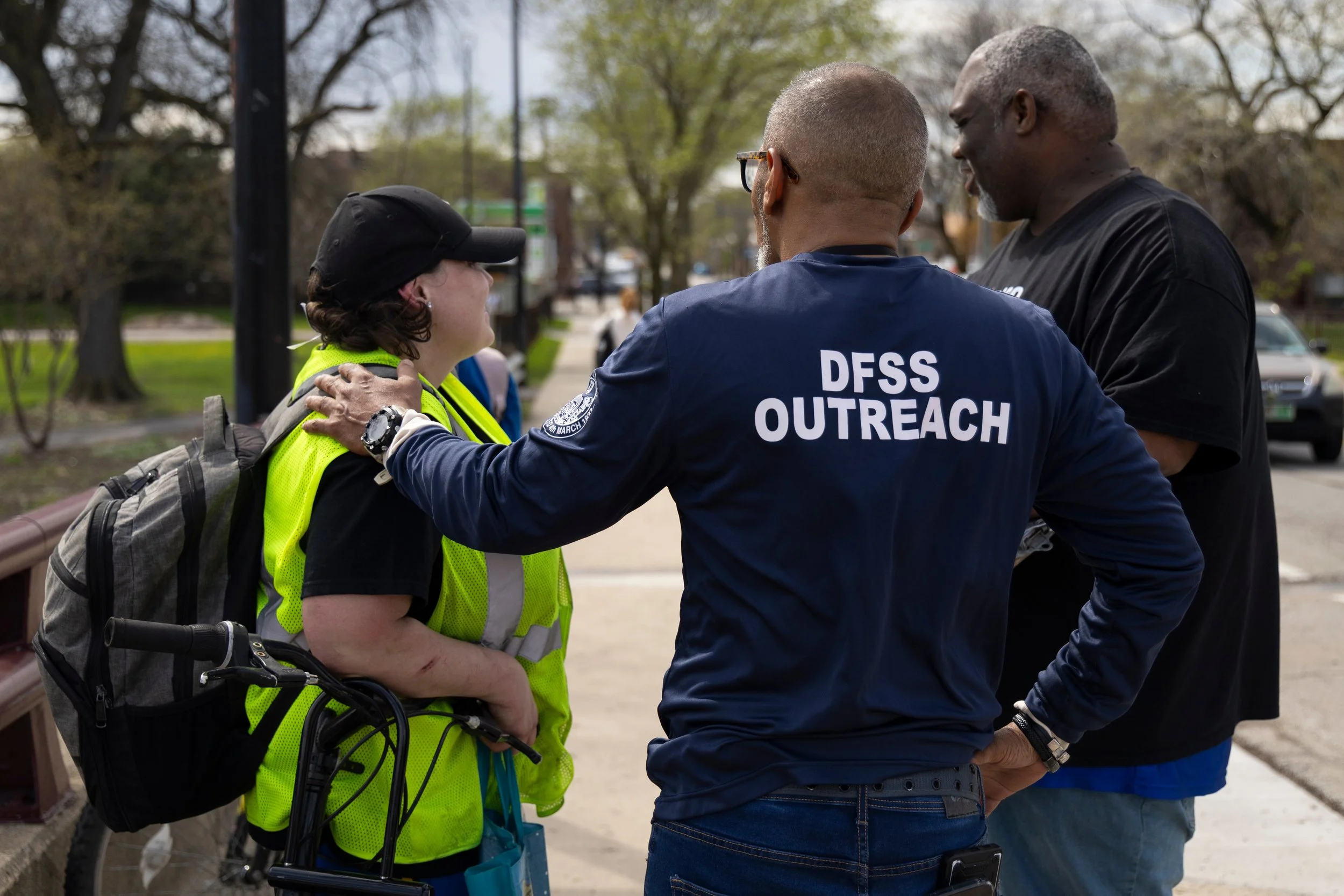
We coordinate closely with the Chicago Department of Family and Support Services (DFSS) to conduct regular outreach to people experiencing homelessness.
DFSS outreach teams offer shelter services and connect people with available resources. Some unhoused residents do not immediately choose shelter due to personal preference or because they are not ready to take that next step. Accepting shelter is voluntary.Our office also works with DFSS to facilitate housing intake for the Coordinated Entry System (CES). The CES uses a standardized housing assessment to understand need and follows a prioritization plan to refer youth, individuals, and families to housing opportunities when they become available.
Unfortunately, Chicago does not currently have an abundant supply of affordable and supportive housing. Housing options are limited, and an intake or referral does not guarantee immediate housing. Detailed timelines cannot be provided for people being matched with housing due to the high demand and low supply across the city.
Alderman Anthony Quezada continues to advocate for greater investment in affordable housing, permanent supportive housing, non-congregate shelter, and other housing options for those experiencing homelessness.
Maintaining Clean and Accessible Public Spaces.
Our office works with the Department of Streets and Sanitation to maintain public spaces and ensure that sidewalks, bike paths, benches, public transit entrances, and other parts of the public way remain accessible.
When appropriate, Streets and Sanitation assists with the collection and disposal of accumulated trash and large unpermitted items at encampments. These efforts focus on maintaining public spaces and addressing health and safety concerns, not criminalizing people for experiencing homelessness or disposing of their personal items.
Connecting People to Additional Resources.
Our office works with neighborhood organizations, community groups, and social service providers to connect unhoused neighbors with additional resources and services. These may include food, clothing, health and wellness services, assistance with acquiring an ID, benefits, case management, and other forms of support.
A Housing-First Approach.
Our office and the City of Chicago take a Housing First approach to homelessness. Housing First recognizes that everyone needs stable housing to have the opportunity to achieve better health, pursue recovery, and thrive. It also recognizes that the path to stability looks different for every person.
Housing First means meeting people where they are and using a trauma-informed approach that respects their dignity, choices, and individual circumstances. It does not require people to meet mandatory conditions before they can receive help. Instead, it means continuously engaging with people experiencing homelessness and responding to what they tell us they need, when they are ready to receive support.
Housing First does not mean “housing only.” Stable housing must be paired with supportive services that are available and accessible to the people who need and choose them. Depending on an individual’s circumstances, these services may include health care, behavioral health services, substance use disorder treatment, employment and education support, case management, or other resources.
For Housing First to work, both housing and appropriate supportive services must be available and accessible. These supports should be individualized rather than imposed as a one-size-fits-all requirement.
Our office believes that homelessness should not be criminalized. People should not be punished simply because they are experiencing poverty or do not have a place to live. Instead, our goal is to connect people with housing and the services they need to maintain that housing and build a stable future. Repeated forced displacement does not address the root causes of homelessness, makes it more difficult for meaningful casework to proceed, and further traumatizes our unhoused neighbors.
For more information about Chicago’s homeless services and available resources, visit the City’s Department of Family and Support Services Homeless Services page: Chicago Homeless Services.
Our office encourages you to learn more about the City’s commitment to addressing homelessness long-term by reading the Five-Year Blueprint on Homelessness.